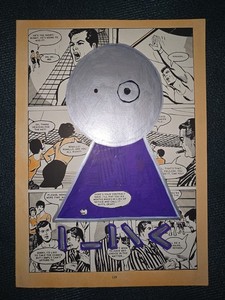
Blink Friction: Sigils, Salvage, and the Living Archive
Press Release
For Immediate Release
Sarnia de la Maré Presents: Blink Friction — Sigils and Salvage
Sarnia de la Maré announces a new body of work under her long-running art practice, Blink Friction, uniting archival stencil imagery with a contemporary personal sigil system.
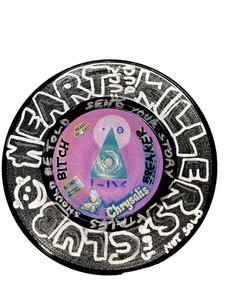
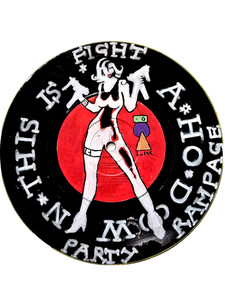
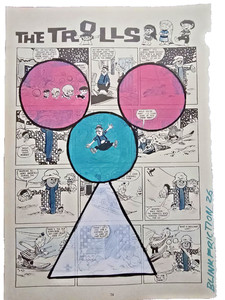
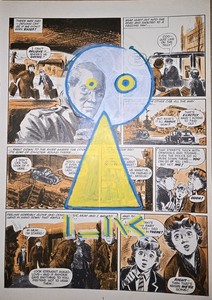
Working with reclaimed vinyl, paper, packaging, and found ephemera, these new works explore continuity, feminine power, memory, and material history. Each piece functions as both artefact and transmission — connecting early street-based practice with present-day symbolic research.
Through layered mark-making, staining, and hand-applied interventions, Blink Friction transforms discarded surfaces into sites of meaning, ritual, and renewal.
This series marks a consolidation of decades of interdisciplinary practice in visual art, film, music, and publishing, positioning the sigil as both signature and living archive.
Introduction: Why Sigils, Why Now
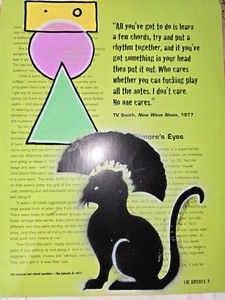
The current Blink Friction series emerges from a return to earlier stencil works and overlooked materials, reactivated through a newly developed personal sigil language.
Rather than functioning as decorative motifs, the sigils operate as anchors — binding time periods, identities, and intentions. They act as seals between past and present, fixing fragments of experience into visible form.
This practice reflects a long-standing interest in symbolic systems, ritual marks, and personal mythology, reframed through contemporary salvage processes.
The Sigil System: Meaning and Structure
Each Blink Friction sigil is built through layered repetition and variation. While no two marks are identical, they share a structural logic.
Key elements include:
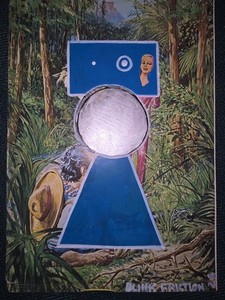
Triangular Forms — referencing balance, body, and continuity
Circular Motifs — cycles, protection, return
Interrupted Lines — fracture, survival, adaptation
Hidden Letterforms — fragments of language embedded within abstraction
The sigils are not static symbols. They evolve through use, material interaction, and surface response. Meaning is generated through process rather than fixed iconography.
In this sense, each mark functions simultaneously as:
Signature
Ritual seal
Archive tag
Feminine-coded power symbol
Feminine Power and Personal Mythology
The sigil practice draws on archetypal and contemporary interpretations of feminine authority — not as ornament, but as infrastructure.
Rather than depicting literal goddess imagery, the work constructs a symbolic presence through repetition, endurance, and material agency.
Power is located in:
persistence
repair
reuse
reactivation
survival
This approach reframes femininity as an operational force: organising memory, shaping environments, and sustaining creative ecosystems.
The Found Object as Canvas
In Blink Friction, the surface is never neutral.
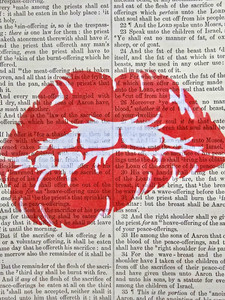
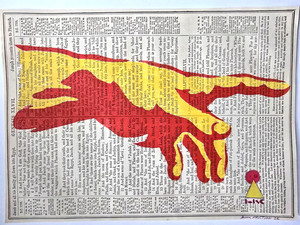
Vinyl records, book pages, packaging, discarded prints, and ephemera arrive already marked by time, use, and circulation. They carry economic, cultural, and emotional residue.
By selecting these materials as primary supports, the work resists blankness.
Each object contributes:
prior history
previous ownership
embedded narratives
physical wear
accidental markings
The artist does not erase these traces. Instead, they are activated as compositional partners.
The result is a dialogue between:
past function and present meaning
mass production and singular authorship
disposability and permanence
Salvage as Method, Not Aesthetic
Salvage within Blink Friction is not a stylistic gesture. It is a structural methodology.
Materials are chosen for durability, availability, and narrative density. The practice prioritises:
waste reduction
material longevity
ethical sourcing
accessibility
circular creative economies
This positions the work within a wider ecology of sustainable making, without sacrificing conceptual rigour or aesthetic complexity.
Process: Layering, Sealing, Transmission
Each work develops through multiple stages:
Surface preparation and assessment
Staining, bleaching, or tonal adjustment
Primary stencil activation
Sigil placement
Secondary mark-making
Sealing and stabilisation
This slow accumulation produces visual depth and structural resilience.
The final surface reads as a palimpsest — a site where multiple temporal layers coexist.
Archive, Continuity, and Living Practice
Blink Friction functions as a living archive rather than a closed series.
Earlier works are not treated as finished chapters, but as active materials for re-entry and reinterpretation.
This approach rejects linear career narratives in favour of cyclical development, return, and renewal.
The sigil becomes a connective tissue linking:
early stencil culture
salvage practice
digital production
contemporary authorship
Collecting and Circulation
Each work is individually produced, documented, and released through direct and curated channels.
Pieces remain accessible while retaining their status as singular artefacts.
This dual positioning reflects the wider Blink Friction ethos: democratic circulation combined with long-term cultural value.
Conclusion: The Sigil as Living Mark
The Blink Friction sigil is not a logo.
It is a living mark — shaped by time, material, repetition, and intention.
Through salvage surfaces and symbolic layering, the practice constructs a contemporary mythology grounded in labour, memory, and resilience.
Each work stands as both record and invitation: a fragment of an ongoing transmission between artist, object, and audience.
Sarnia de la Maré
Artist, Author, Filmmaker
For press enquiries, commissions, or acquisitions, please visit the official website or authorised platforms.